

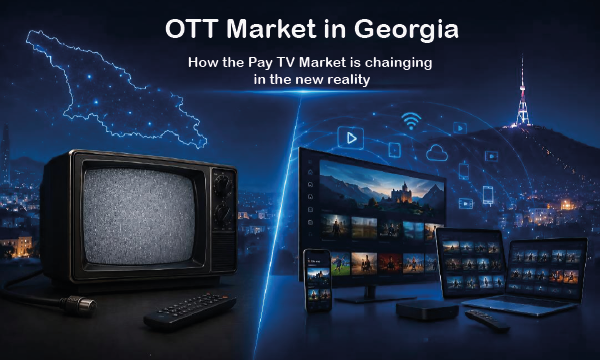
Television viewing habits are changing rapidly around the world, and Georgia is no exception. For viewers, television is no longer simply a collection of channels delivered through cable or IPTV networks. The development of the internet and the growing adoption of smartphones, Smart TVs and other connected devices have given consumers the ability to watch the content they want, whenever and wherever it is convenient for them. One of the key manifestations of this transformation is OTT (Over-the-Top) - the delivery of television and video content over the internet without relying on traditional television networks.
The development of OTT presents a new challenge for traditional television operators. Georgian telecommunications companies are responding to changing consumer behaviour by developing OTT services, applications, VOD platforms and multiscreen offerings.
Data from the Georgian market over recent years clearly reflects this transformation. In 2020, IPTV accounted for approximately 76% of the Pay TV market, while by 2025 its share had increased to around 87%. During the same period, the share of traditional coaxial cable television declined from 3.6% to 1.8%. This means that the fundamental transformation of Georgia's television market has already taken place - consumers have shifted from traditional cable networks towards IP-based services.
However, OTT represents the next stage of this transformation. While IPTV changed the technology used to deliver television signals, OTT is changing the consumption model itself. Consumers no longer need to be permanently tied to a specific network or a single device. This makes it particularly interesting to examine how Georgian operators are responding to this new reality, what products they are offering, and how competition between Pay TV, IPTV and OTT services is evolving.
In this context, the strategies of Georgia's two largest players - Magticom and Silknet - are particularly noteworthy. Alongside the development of OTT, both companies have actively expanded their internet-based television services.
Magticom has introduced MAGTI TV PLAY, an app-based television service that can be accessed via a smartphone or other compatible device connected to the internet. The service is not limited exclusively to Magticom's IPTV network and can also be used by customers of other internet providers. Currently, the free Magti TV Play package includes 10 channels, while the standard paid package offers access to 22 channels.
Magticom has also expanded its IPTV platform with additional OTT/VOD content. The Cavea+ TV application provides Magticom IPTV customers with access to movies and series for a monthly fee. The company also offers an integrated Setanta Sports application, providing access to sports content. YouTube is also available to the company's subscribers completely free of charge.
In the case of Silknet, the OTT direction is even more clearly defined. The company offers SILK TV OTT, which allows users to watch Georgian television channels over the internet, including from outside Georgia. The service does not necessarily require a Silknet internet connection and currently provides access to more than 205 channels.
Silknet is also developing the Silk Go application, which allows users to watch Silk TV channels and access its video library on different devices. In addition, the company offers special packages, including a Megogo TV and movie package. A large share of the movies and series included in the TV and movie package is dubbed in Georgian.
The development of OTT in Georgia is not limited to the country's two largest companies. However, smaller and medium-sized operators are taking a somewhat different approach. Instead of developing standalone OTT platforms, they are primarily enriching their IPTV services with streaming and VOD applications and integrating digital content into their TV boxes. One example is Akhali Kselebi. The company has integrated 1TV Play into its IPTV platform, allowing customers to access Public Broadcaster digital content directly from the TV box without the need for additional devices. The company also offers Setanta Sports and Ivi online cinema services.
The development of OTT is changing the logic of competition. In the past, operators primarily competed on the number of channels, package prices and network coverage.
Today, competition is increasingly shifting towards mobility, multiscreen access, applications, VOD content and the ability to provide television services to consumers wherever they are. The process is gradual, but steady.
As a result, IPTV and OTT are no longer simply competitors. It would be more accurate to view them as interconnected services: IPTV provides the core traditional television package, while OTT adds flexibility, mobility and on-demand content.
The next stage of Georgia's television market is likely to be not simply the rapid expansion of OTT, but an even greater integration of IPTV and OTT. In the future, competition among operators will no longer be based solely on the number of channels and subscription prices. Consumers will increasingly expect access to content anytime and on any device. As a result, operators' own OTT applications, Smart TV accessibility, mobile viewing, content archives, VOD services and the integration of multiple streaming platforms into a single environment will become increasingly important.
The hybrid model will be particularly important in this process. For large operators, OTT may serve not only as a standalone product but also as a means of expanding their existing television services. The structure of the market provides a strong basis for this development. According to data for the first quarter of 2026, the IPTV market is highly concentrated among two major operators. Magticom holds 52.8% of the market, while Silknet accounts for 38.8%, with all other operators collectively representing 8.7%.
Based on these figures, it can be assumed that the role of traditional cable television will continue to decline.
For traditional cable operators, development does not necessarily mean building their own infrastructure, which requires significant investment. An alternative is to make third-party OTT platforms their partners and add them to their own service offerings - for example, sports, movie or other streaming applications. The strengths of smaller operators often include fast technical support, direct communication with customers and flexible pricing. Therefore, in the OTT era, smaller operators can maintain their competitive position through partnerships, flexible packages and close relationships with their customers. Ideally, for these operators, the key to survival will be a timely transition to digital platforms.
Market analysis shows that the development of OTT in Georgia does not mean the end of traditional television. Rather, it represents a transformation of the Pay TV market. For operators, long-term success will depend largely on their ability to adapt to evolving digital consumer demands.
Teona Beruashvili
Executive Director
Electronic Communications Association of Georgia
Sources:
https://comcom.ge/ge/
https://analytics.comcom.ge/
https://www.magticom.ge/
https://silknet.com/
https://ak.ge/

