

Key Terms
- OTT (Over-the-Top) - a technology that delivers television channels, video, audio and other digital content to users over the internet.
- IPTV (Internet Protocol Television) - television delivered over an Internet Protocol-based network.
- Pay TV - a television service that requires users to pay a recurring subscription fee.
- VOD (Video on Demand) - a video-on-demand service (online cinema).
- AVOD (Advertising Video on Demand) - an ad-supported video-on-demand service.
- SVOD (Subscription Video on Demand) - a video service based on a subscription model.
- BVOD (Broadcaster Video on Demand) - an online video-on-demand service operated by a broadcaster.
- FAST TV (Free Ad-Supported Streaming TV) - free streaming television funded by advertising.
Today, Azerbaijan's market includes several IPTV and OTT platforms, including mobile operators that have launched their own VOD platforms. However, due to the widespread availability of pirated resources, legal platforms face difficulties in growing their subscriber bases. As a result, many lack sufficient financial resources to acquire and dub content and to produce local programming.
The main platforms operating in the market include CityNet, Kontakt TV, Metaflix, KinOn, Kinobox and TvSeans.
Metaflix and Kinobox are the leading platforms in terms of local content production.
CityNet and KinOn operate as ecosystem platforms, offering not only television services but also fiber-optic internet, 5G network services and bonus programs provided in partnership with mobile operators.
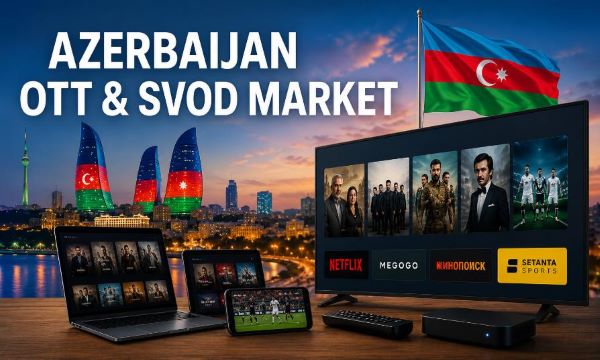
Almost all major international OTT platforms are also available in Azerbaijan. The most popular include Netflix, Megogo, Kinopoisk and Setanta. However, subscriptions to foreign platforms that are not officially licensed in Azerbaijan are subject to additional VAT.
To date, approximately AZN 9 million has been invested in the development of local OTT and VOD platforms. In addition, at least AZN 3 million needs to be reinvested annually in content acquisition, dubbing, and the production of local films and series.
Approximately 50,000 subscribers are required for a platform to operate sustainably and recover its investment. Subscription revenue remains the primary source of income, while the average subscription fee in the industry is around AZN 5. Revenue from advertising and international content distribution can cover approximately 20% of total costs.
Online cinemas should develop joint projects with local production studios and television channels. A co-production business model reduces costs and risks, creates opportunities to share investment, and combines marketing and creative resources.
The number of active users of streaming platforms, IPTV and OTT services in Azerbaijan exceeds 350,000. Of these, approximately 220,000 users rely on pirated resources to watch sports broadcasts and other audiovisual content.
Given that the official Pay TV market does not exceed 130,000 subscribers, the number of users of pirated platforms and websites has already surpassed the number of subscribers to legal services, including local cable television services.
Against the backdrop of growing high-speed internet penetration in the country, effective measures against broadcast piracy are essential for the development of the industry and the advertising market.
Eliminating broadcast piracy would significantly increase the volume of legal media consumption and encourage greater investment in platforms. If illegal services disappear from the market, a significant share of users is expected to migrate to legal services.
According to 2025 data, legal Pay TV operators generated approximately AZN 7.8 million in revenue. If piracy is reduced, this figure could increase to AZN 15 million. Television piracy alone causes broadcasters more than AZN 7.2 million in economic losses annually. This figure does not include losses incurred by the film industry, legal platforms and the state budget as a result of online cinemas and pirated websites.
The structure of pirated content consumption is as follows:
- Films - 33%
- TV series - 48%
- Television programs - 5%
- Sports broadcasts - 14%
Pirated websites frequently carry advertising, including advertisements for betting platforms and unlicensed services prohibited in Azerbaijan. Such websites also expose users to significant cybersecurity risks, ranging from malware to the theft of personal data.
The launch of İTV and Xezer TV BVOD platforms is planned for 2027. Unlike operator-owned platforms, media holdings produce or commission their own films, series and television programs, giving them a competitive advantage.
Television broadcasters also have another significant advantage: they receive grants from government institutions and regulators to support content production. These include the Media Development Agency of the Republic of Azerbaijan (MEDİA), the Ministry of Culture - including the State Film Fund, ARKA, the Creative Industry Center and Azerbaijanfilm - as well as the Ministry of Youth and Sports.
Given that content consumption on online platforms exceeds three hours per day and competes with the audience of national television channels, the market is expected to develop AVOD and FAST TV models alongside subscription-based revenue. These models would create additional opportunities to generate advertising revenue. Market participants also associate the positive growth dynamics with an increase in the number of active users.
Although partnership projects involving Russian platforms ivi and Megogo have exited the market, Kinopoisk is expected to enter Azerbaijan as part of the Yandex+ ecosystem subscription, which includes Yango, Yandex Music and Kinopoisk. In the absence of strong ecosystem platforms in the region, Kinopoisk has a good opportunity to establish a leading position. However, its main limitation remains the relatively small share of the Russian-speaking population, estimated at approximately 18%.
There is also ongoing discussion about the creation of a new OTT platform under the AZCON holding, which would integrate the capabilities of Azercell, Aztelekom, Teleradio and Azerkosmos. The project envisages integrating Azerkosmos satellite broadcasting, the KinOn platform and digital terrestrial broadcasting into a unified system, through which national television channels would be distributed via an authorized digital platform.
The system would provide rights holders and broadcasters with additional monetization opportunities, for example through the placement of pre-roll advertising during streaming and the replacement of traditional advertising blocks.
The project would operate as a unified streaming player, allowing broadcasters to control their own broadcasts, analyze their audiences and manage advertising insertions. This would also create new opportunities for small and medium-sized businesses.
The strategic objectives of the OTT platform are:
- To enable media holdings to maintain the original quality of their broadcasts and protect their content from illegal copying and unauthorized online retransmission;
- To ensure effective content protection;
- To provide alternative analytics of television audiences.
Source: Ali Aliyev, Executive Director, Association of Azerbaijan Digital and Audiovisual Broadcasting Industry, Facebook post, 30 July 2026

