

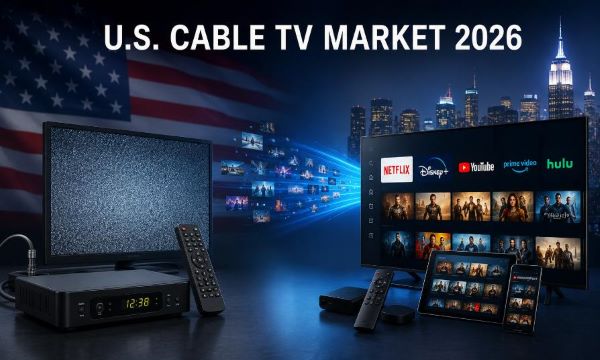
Over the past 15 years, the television industry has undergone its most significant transformation to date. While the majority of U.S. households relied on cable or satellite television in 2010, internet-based streaming had become the dominant platform by 2026. Traditional operators are no longer competing solely with one another-their primary competitors are now OTT (over-the-top) platforms such as Netflix, YouTube, Disney+, Amazon Prime Video, and others.
Since 2010, the U.S. pay TV market has lost approximately 36 million subscribers, and the downward trend continues.
- 2010: 105 million subscribers
- 2023: 72 million subscribers
- 2026: 68.7 million subscribers
Consumers are leaving traditional cable television for a variety of reasons, but the most significant factors are the rapid growth of streaming services and changing viewing habits among younger generations.
Today, approximately 66% of U.S. households no longer subscribe to a traditional pay TV service.
According to Nielsen, television viewing was distributed as follows by the end of 2025:
- Streaming: 47.5%
- Broadcast television: 21.4%
- Cable television: 20.2%
As subscriber numbers continue to decline, subscription prices continue to rise.
According to 2023 data, the average U.S. household spent approximately $1,600 per year on cable television services. By 2026, the average annual cost had increased to approximately $1,764.
Several factors have contributed to rising subscription fees, including higher network maintenance costs spread across a shrinking subscriber base, increasing licensing fees for sports channels and premium content, and growing infrastructure and labor costs.
Streaming services have also become more expensive. Today, the average U.S. household spends approximately $69 per month on streaming subscriptions.
The business strategy of U.S. pay TV operators has also evolved significantly. Rather than focusing on attracting mass-market subscribers, operators are increasingly targeting higher-value customers who continue to demand live sports, local television channels, news programming, and other live content.
At the same time, operators are increasingly launching their own streaming platforms or integrating streaming services into their existing television offerings.
Major operators such as Comcast and Charter have transformed their business models by placing greater emphasis on broadband internet, mobile services, the integration of streaming platforms, and the separation of their content businesses. Reflecting this strategy, Comcast has announced plans to split the company into two separate businesses. One will focus on media assets, including NBCUniversal and Sky, while the other will concentrate on broadband and wireless services. As Comcast Chairman and CEO Brian Roberts stated, "The world is changing faster than ever."
If current trends continue, traditional cable television in the United States is expected to evolve into a premium and niche service over the next three to five years, while the mass market will shift almost entirely toward internet-delivered television and streaming services.
Key Market Trends
1. Cable television services are becoming more expensive as fewer subscribers are required to support the same network infrastructure.
2. Streaming has become the leading television platform, surpassing cable for the first time in total television viewing share.
3. Traditional pay TV is retained primarily for live sports, news, and local television channels.
4. Broadband internet has become the core product, while television has increasingly become an additional service offered by many operators.
Source:
www.cablecompare.com
www.cable-tv.com
www.spglobal.com
www.reuters.com
www.nielsen.com
www.adwave.com
www.mediasat.info
www.kiplinger.com
www.apnews.com

