

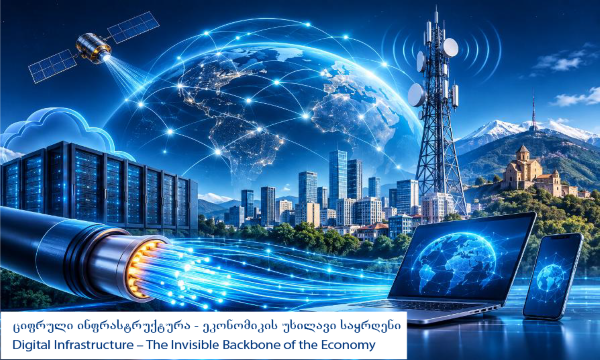
Telecommunications networks are one of the key prerequisites for modern economic development, competitiveness and national resilience.
Today, as almost every sector of the economy transitions towards digital technologies, the foundation that makes this transformation possible often remains overlooked: digital infrastructure.
We use the internet every day, conduct banking transactions, work remotely, access digital public services, watch television content and communicate with people anywhere in the world. Yet we rarely consider what makes these opportunities possible: fibre-optic networks, communication cables, data centres, mobile network base stations and other technological systems that ensure the continuous and rapid transmission of information.
This infrastructure is, in many ways, the invisible backbone of the modern economy. When it functions properly, digital services operate seamlessly, businesses grow and citizens gain access to greater opportunities. However, when networks experience disruptions or their development fails to keep pace with demand, the impact extends far beyond telecommunications. It affects economic activity, education, healthcare, public services and the country's overall competitiveness.
The digital economy cannot be built on software and modern devices alone. It requires a solid physical foundation on which all other technologies depend.
Digital Infrastructure - Much More Than the Internet
Digital infrastructure is not limited to internet connectivity. It encompasses the technological systems that enable information to be transmitted, stored and processed.
Its main components include:
Fibre-optic networks - the foundation for the fast and reliable transmission of large volumes of data, connecting cities, regions, businesses and consumers.
Mobile telecommunications networks - 4G and 5G technologies that provide wireless connectivity and create the foundation for the development of new digital services.
International communication cables - including submarine fibre-optic cables through which countries connect to the global internet.
Data centres and cloud infrastructure - systems where digital information is stored and processed and which support the operation of many modern online services.
Internet exchange points and network nodes - infrastructure that enables more efficient data exchange between different networks.
Together, these components form the system on which the modern digital economy depends.
It is important to understand that developing this infrastructure is not merely a matter of technological progress. It is directly linked to a country's economic potential. The more advanced, accessible and reliable telecommunications networks are, the greater the opportunities businesses have to adopt modern technologies, expand their operations and compete with companies in international markets.
How Does Digital Infrastructure Transform the Economy?
The economic significance of digital infrastructure becomes most apparent when we examine its impact across different sectors.
Business and Trade
For modern businesses, the internet is no longer merely a means of communication. It has become an integral part of their operations. E-commerce, electronic payments, remote services, communication with international partners and the use of cloud technologies all depend on reliable connectivity.
High-speed internet also enables small and medium-sized businesses to reach customers beyond their national borders. As a result, geographical barriers are reduced and the scope of economic activity expands.
Education and Human Capital
Digital infrastructure is also transforming access to education. Distance learning, international educational platforms, online courses and digital libraries allow people to access knowledge regardless of where they live.
This is particularly important for rural and remote communities, where physical access to educational resources may be limited.
Healthcare
Telemedicine, electronic patient records, remote consultations and information exchange between healthcare facilities all require reliable telecommunications networks.
Consequently, the development of digital infrastructure helps improve access to healthcare services and enables more efficient use of medical resources.
Public Services
E-government, digital document management, public registry services and online administration reduce the time and resources required from citizens and businesses.
However, the effectiveness of these services depends not only on software but also on the quality and availability of internet connectivity throughout the country.
According to the World Bank, a 10% increase in broadband penetration in low- and lower-middle-income countries may be associated with GDP growth of up to 2%. This demonstrates that digital connectivity is not simply a technological convenience; it has significant potential to support economic development.
Why Is Fibre-Optic Infrastructure Strategically Important?
As digital technologies evolve, the volume of data and the demands placed on networks continue to grow. The distribution of high-definition video content, cloud services, artificial intelligence, connected devices and industrial automation all require increasing network capacity and stable connectivity.
Under these conditions, fibre-optic networks are becoming particularly important.
Their advantages go beyond high speeds. Optical technology enables the transmission of large volumes of data, increased network capacity and adaptation to future technological requirements.
For this reason, fibre-optic infrastructure should be viewed as a long-term investment rather than simply a means of meeting today's demand.
Another important consideration is that the development of mobile networks also relies heavily on fixed infrastructure. The effective operation of 5G requires reliable connections between mobile base stations and core networks, which are often provided by fibre-optic infrastructure.
Fixed and mobile networks are therefore not alternatives to one another, but complementary components of the modern telecommunications ecosystem.
According to 2025 data from the Organisation for Economic Co-operation and Development (OECD), the share of gigabit-speed offers in the fixed broadband market across OECD member countries increased sixfold between 2019 and 2024. This trend clearly demonstrates the rapidly growing demand for high-capacity networks.
Digital Infrastructure and Regional Development - Connectivity That Creates Equal Opportunities
One of the major challenges facing the digital economy is the digital divide.
Despite technological progress, access to high-speed internet is not equally available in all settlements. Significant differences often remain between urban populations and people living in regional areas, both in terms of network availability and service quality.
These differences go beyond internet speed. They affect employment opportunities, access to education, business development and participation in public life.
An entrepreneur living in a region who has access to reliable internet can use e-commerce to sell products anywhere in the country or reach international markets. Students can access the same educational resources available to their peers in the capital. Local businesses can also cooperate with international partners remotely.
For this reason, connecting regional communities to the internet is not merely a technical project. It is an important instrument of economic and social development.
This issue is particularly important for Georgia. The country's geographical characteristics, mountainous settlements and relatively low population density in certain regions make infrastructure development more complex and costly. Under these circumstances, the involvement of both the public and private sectors becomes essential.
According to the 2025 activity report of the Georgian National Communications Commission, the total length of completed and ongoing works under the state programme "Log-in Georgia" reached 3,000 kilometres. The project covered more than 420 settlements and approximately 260,000 residents. Eighteen internet service providers and three mobile operators were already using this infrastructure.
Log-in Georgia is a project implemented under the State Programme for the Development of Broadband Infrastructure by the non-entrepreneurial (non-commercial) legal entity Open Net, with the support of the World Bank and the European Investment Bank (EIB). Its primary objective is to expand access to the internet throughout the country and promote its use. This objective is fully aligned with the state's development priorities, including increased competition in the telecommunications market, attracting investment to the regions and developing digital skills.
The existence of such a project demonstrates how important it is to ensure accessibility alongside infrastructure development. Building the network is only the first step; the ultimate goal is to ensure that people actually receive high-quality services.
Investment and Competition - Who Should Build the Digital Future?
The development of digital infrastructure requires substantial financial resources. Network construction, modernisation, maintenance and the introduction of new technologies all require continuous investment.
Private telecommunications companies play a decisive role in this process. Operators are responsible for building networks, expanding coverage, introducing new technologies and providing telecommunications services to consumers.
However, infrastructure development cannot depend solely on the capabilities of private companies. In regions with low population density, where recovering network construction costs may be commercially challenging, public sector involvement and appropriate investment mechanisms are necessary.
A competitive market environment is particularly important in this context.
Healthy competition encourages operators to improve service quality, introduce innovations and use resources more efficiently. At the same time, it is important to ensure that both major national companies and smaller regional operators have opportunities to develop.
Regional operators often play an important role in settlements where larger companies have relatively limited commercial incentives to invest. Their activities help connect local communities and maintain competition.
Therefore, the development of the telecommunications market should not mean strengthening large companies alone. It is important to create an environment in which operators of different sizes have genuine opportunities to invest, grow and continue their activities in the market.
The sustainable development of infrastructure and the protection of consumer interests depend on maintaining this balance.
Digital Infrastructure and National Security
The importance of digital infrastructure extends beyond economic development. It is also becoming an essential component of national security.
The functioning of modern states increasingly depends on electronic communications. Banking, energy, transport, healthcare, government institutions and other critical sectors all require the uninterrupted exchange of information.
Consequently, disruptions to communication networks can have a significant impact on both economic activity and the functioning of public services.
Network resilience is particularly important. This refers to the ability of networks to withstand technical failures, cyberattacks, disruptions to electricity supply and other unforeseen events.
Achieving this requires:
- Developing alternative network routes to ensure that damage to a single section does not disrupt connectivity entirely;
- Diversifying international communication channels;
- Protecting data centres and critical network nodes;
- Implementing modern cybersecurity standards;
- Establishing business continuity plans to ensure uninterrupted telecommunications services during crisis situations.
Particular attention must also be paid to international communication cables. A significant proportion of global internet traffic is transmitted through submarine fibre-optic cables. Damage to these cables can affect not only individual operators but also the connectivity of several countries.
For this reason, digital infrastructure security must be regarded as a strategic national priority requiring coordinated action by the government, the regulatory authority and the private sector.
Artificial Intelligence and Emerging Technologies - The Future Is Already Here
Demand for digital infrastructure is increasing even further as artificial intelligence develops rapidly and becomes integrated into various sectors of the economy.
Artificial intelligence systems require large volumes of data, powerful computing resources and fast, stable connectivity. The same applies to the Internet of Things (IoT), smart cities, automated manufacturing and other emerging technologies.
For example, the functioning of a smart city involves connecting various systems, including traffic management, energy consumption monitoring, security cameras and municipal services.
All of this would be impossible without appropriate telecommunications infrastructure.
In the future, the most competitive countries will be those that are not merely consumers of digital services but also develop the infrastructure required to create and deploy them.
The European Union has a clear strategic vision in this area. Under its Digital Decade framework, one of the objectives is to ensure that all populated areas of the EU are covered by 5G networks by 2030, while all households have access to gigabit connectivity. These targets demonstrate that digital infrastructure has become a strategic development priority for advanced economies.
Key Next Steps for Georgia
For Georgia, the development of digital infrastructure is one of the important prerequisites for strengthening economic growth, regional development and international competitiveness.
The country has already taken significant steps towards expanding access to broadband internet and extending fibre-optic networks. However, technological progress continuously changes demand, making it essential not only to preserve the achievements already made but also to plan the next stage of development.
Several areas require particular attention in this process:
Expanding geographical coverage. High-speed internet should be accessible not only in major cities but also in smaller settlements and mountainous regions.
Modernising existing networks. It is important not only to expand coverage but also to improve network capacity, reliability and service quality.
Encouraging private investment. Telecommunications infrastructure is a capital-intensive sector. Therefore, predictable regulation, transparent conditions and a business environment that encourages companies to make long-term investments are essential.
Safeguarding competition. Large and small operators should have equal opportunities to develop in the market. Maintaining competition ultimately serves the interests of consumers as well.
Strengthening infrastructure resilience and security. Network development must take into account not only current requirements but also potential technological, technical and security challenges.
Developing digital skills. Access to the internet alone does not guarantee full participation in the digital economy. It is essential to strengthen people's knowledge and skills so that they can make effective use of available technological opportunities.
Thus, in the era of digital transformation, the development of countries increasingly depends on how strong, accessible and reliable their telecommunications infrastructure is.
The internet, fibre-optic networks, mobile connectivity and other data transmission systems are no longer merely technical means of communication. They form the foundation of economic activity, innovation, education, public services and international cooperation.
For this reason, the development of digital infrastructure should not be viewed solely as an interest of the telecommunications sector. It is a matter of the country's overall economic and strategic development.
It is important that infrastructure development does not focus exclusively on building new networks. Modernising existing networks, encouraging investment, maintaining a competitive environment and improving service quality are equally important.
The success of the digital economy depends not only on the technologies we introduce today but also on how prepared we are to build infrastructure capable of meeting the demands of tomorrow.
Digital infrastructure may remain largely invisible in our everyday lives, yet it supports a substantial part of the modern economy. Its development means more than just faster internet: it means stronger businesses, greater opportunities for regional communities, better public services and a stronger position for the country in the global economy.
Sources and Further Reading
- World Bank - Digital Infrastructure and Economic Growth.
- OECD - Fibre and 5G Drive Digital Transformation (2025).
- European Commission - Digital Connectivity Strategy.
- Georgian National Communications Commission - 2025 Report on the Internet Connectivity Programme.
- International Telecommunication Union (ITU) - Digital Infrastructure Investment (2025).

