

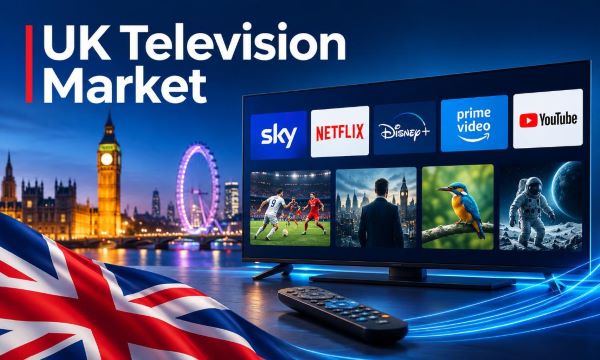
The United Kingdom has one of the world's most developed and competitive television markets. It provides a clear example of how the rapid growth of over-the-top (OTT) streaming platforms is reshaping the traditional television industry, changing consumer viewing habits, and prompting operators to adopt new strategies to maintain their competitive positions.
Between 2023 and 2026, the UK television market entered a new phase of significant transformation.
The UK is home to approximately 29 million households. Around 10-11 million households continue to subscribe to traditional pay TV services, including Sky, Virgin Media, EE TV, and others, while approximately 68-69% of households use at least one OTT streaming platform such as Netflix, Amazon Prime Video, Disney+, or similar services.
The number of pay TV subscribers has continued to decline in recent years. In 2023, there were approximately 12.5 million active pay TV subscribers, falling to around 11 million by 2026. The primary driver of this decline has been the continued expansion and growing popularity of OTT streaming platforms.
Sky remains the UK's largest pay TV operator, holding approximately 70% of the market.
In the UK, television services are typically offered as part of bundled packages that include broadband internet.
Average monthly subscription fees are as follows:
- Basic TV package: £20-35
- TV and broadband bundle: £40-70
- Premium sports and movie packages: £80-120+ per month
Adding Sky Sports, TNT Sports, or Cinema packages significantly increases the monthly subscription fee. According to Ofcom, the prices of premium television packages have steadily increased over recent years.
In response to declining subscriber numbers, UK operators have reduced the prices of their entry-level TV packages to retain price-sensitive customers. At the same time, premium sports and entertainment content has remained expensive-or become even more costly-as it continues to represent pay TV's strongest competitive advantage over OTT streaming services.
The way audiences consume television is also evolving rapidly.
Between 2023 and 2026, traditional television viewing declined by approximately 3-5%. However, the pace of decline has slowed compared with previous years, while the consumption of streaming services and online video platforms has continued to grow.
The market is increasingly moving toward a hybrid viewing model, in which consumers use both traditional pay TV and OTT streaming services simultaneously. Live sports broadcasting remains the key factor that keeps audiences connected to traditional television, generating substantial-although temporary-increases in viewership. For example, the 2026 FIFA World Cup attracted an audience of up to 15 million viewers across the UK.
Sky, the country's leading pay TV operator, provides one of the best examples of this transition. Rather than relying solely on its traditional television service, the company has developed Sky Stream and Sky Glass, both of which operate entirely via broadband internet. It has integrated Netflix, Disney+, Discovery+, Prime Video, and Sky's own content into a single user interface, creating a seamless viewing experience. In addition, Sky introduced the lower-priced Essential TV package to retain price-sensitive subscribers. As a result, Sky no longer sells television as a standalone product; instead, it has positioned itself as an aggregator of multiple streaming services.
Other UK operators have adopted similar strategies, demonstrating that they are no longer competing directly with Netflix and other OTT platforms. Instead, they are integrating these services into their own ecosystems. Today, operators are no longer selling television channels alone-they are offering comprehensive entertainment packages that combine broadband internet, television, streaming services, and premium sports content under a single subscription.
The UK experience demonstrates that the future of the television industry lies not in the disappearance of traditional television but in its integration with digital platforms. As a result, the development of OTT services is no longer viewed as an optional addition but as a strategic necessity for operators seeking to remain competitive in an increasingly digital media landscape.
Source:
www.ofcom.org.uk
www.broadcastnow.co.uk
www.theguardian.com
www.reuters.com
www.tvbeurope.com
www.gov.uk
www.advanced-television.com
www.barb.co.uk

